
Services / Visure 360
Strategic & Operational Business DiagnosticKnow what to fix before you spend more time or money.
Visure 360 gives leadership a structured view of where performance may be lost, which opportunities are worth validating, and what should happen next.
The standard engagement is built around one intensive day inside the business, followed by a written report delivered within five business days.

Most growing businesses do not have a shortage of possible projects. They have a sequencing problem.
A new hire, campaign, system, automation, or process change may help, but only if it addresses the right constraint.
Without a connected view of the business, companies can invest time and money in solutions that improve one symptom while leaving the underlying problem untouched.
Visure 360 creates the clarity needed to compare opportunities, identify what still needs validation, and choose the next move with greater confidence.
Visure 360 may be the right starting point when:
- The business has grown, but visibility and control have not kept pace.
- Leadership sees recurring problems but lacks agreement about their causes.
- The company is considering a major hire, system, expansion, or operational change.
- Performance information is fragmented or difficult to trust.
- The owner remains the connection point for too many people and decisions.
- Several projects compete for limited time, capital, and team capacity.
- Leadership wants an objective diagnostic before committing to a solution.
A connected review of the factors influencing performance
The diagnostic is adapted to the business and may examine:
Strategy & Direction
Goals, priorities, constraints, decision criteria, initiatives, and alignment between stated direction and current execution.
Revenue & Customer Flow
Lead capture, response, follow-up, conversion, customer experience, retention, reactivation, and missed opportunities.
Operations & Processes
Workflow, ownership, handoffs, capacity, delays, rework, quality, standardization, and dependence on individual knowledge.
Management & Accountability
Roles, recurring decisions, communication, meeting routines, escalation, leadership visibility, and follow-through.
KPIs & Business Information
Measures, reporting, targets, data sources, reliability, and whether information leads to action.
Technology & Automation
Current systems, integrations, manual work, adoption, automation opportunities, and alignment between tools and business needs.
Costs & Potential Value
Avoidable effort, revenue leakage, capacity constraints, cost drivers, and opportunities that warrant deeper validation.

An intensive day focused on how the business actually works
The standard Visure 360 engagement is centered on one dedicated day at the client’s business. The exact agenda is designed around the objective and may include operational observation, interviews, process walkthroughs, data review, and working sessions with relevant team members.
Owner participation is strongly encouraged because it improves context and decision alignment, but it is not mandatory. A designated decision-maker and the people closest to the areas being examined should be available as needed.
Remote or expanded formats may be proposed when the objective, location, or complexity requires a different approach.
From request to written delivery.
Each step has a clear purpose, and nothing moves forward without a written scope.
- 01
Request an Assessment
Submit a short description of the business, the challenge, and the decision you are trying to make.
- 02
Fit Review
Visure reviews the request. If the situation appears to be a potential fit, you will be invited to purchase an Initial Business Review.
- 03
Initial Business Review $500 · credited to Visure 360
The review costs $500 and includes Visure’s review of the submitted context followed by one business meeting. Payment is required before scheduling. If Visure 360 is contracted within 30 calendar days after the meeting, the full $500 is credited toward the Visure 360 fee.
- 04
Scope & Preparation
If Visure 360 is the recommended next step, the final scope, onsite agenda, information request, participants, travel requirements, and fee are confirmed in writing.
- 05
Intensive Diagnostic Day
Visure examines the business onsite through observation, conversations, information review, and analysis focused on the agreed objective.
- 06
Written Delivery
The diagnostic report is delivered within five business days after the onsite day.
- 07
Optional Next Phase
Any follow-up meeting, workshop, implementation, or continuing advisory support is proposed and priced separately.
A decision tool, not a generic report
Diagnostic Summary
A clear explanation of the current situation, the main constraints observed, and why they matter.
Three to Ten Prioritized Opportunities
A focused set of improvement opportunities with the potential to strengthen performance, increase revenue, reduce costs, improve control, or reduce operational risk.
Value Map
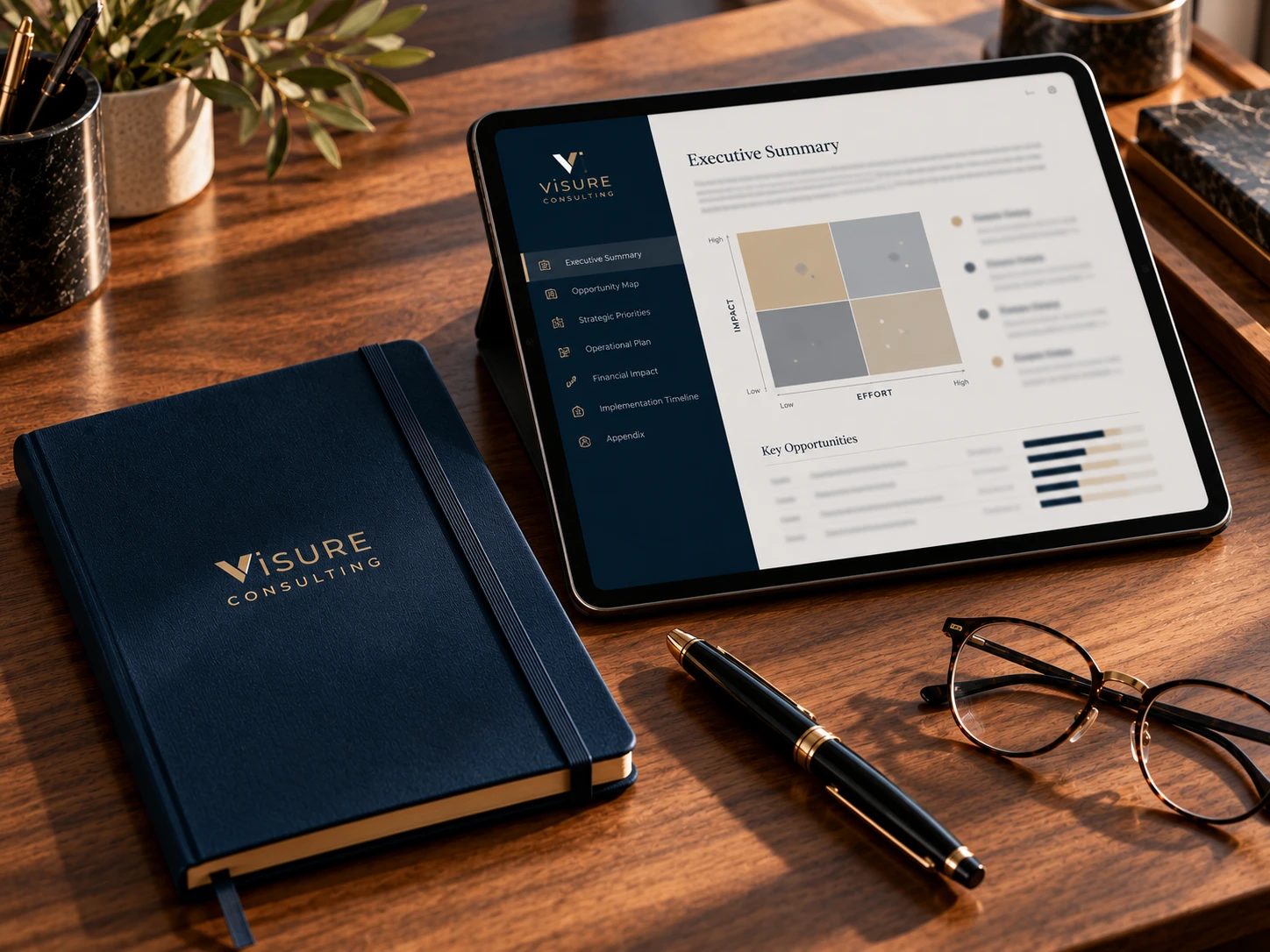
A structured view connecting each meaningful opportunity to the business problem, available evidence, assumptions, potential impact, effort, confidence, dependencies, and validation needs.
Prioritized Roadmap
A practical sequence separating immediate actions, validation work, medium-term projects, and initiatives that should wait.
Implementation Guidance
Recommendations about what the internal team may be able to handle, where Visure can support implementation, and where qualified legal, accounting, tax, or other specialized professionals may be required.
A business case without pretending the estimate is a guarantee.
The Value Map gives leadership one framework for comparing different opportunities. It makes the assumptions behind each estimate visible and identifies what information is still required before a decision is made.
Potential financial and operational impact is presented as a scenario based on the information available at the time. It is not a forecast, guarantee, or promise of results.

| Opportunity | Business problem | Potential impact | Effort | Confidence | Sequence | Next step |
|---|---|---|---|---|---|---|
| Reactivate inactive customers | Existing customers are not segmented or followed up | Low | Medium | Now | Size the inactive base and test one follow-up routine | |
| Standardize the intake handoff | Rework between front desk and operations | Low | High | Now | Map the current handoff with the people who do it | |
| Weekly performance review | Numbers exist but do not guide decisions | Medium | High | Next | Define five core measures and one owner for each | |
| New scheduling platform | Capacity is hard to see and plan | High | Low | Later | Revisit after the handoff and review routine are in place |
Clear boundaries support better work.
Unless included in a separate written scope, the standard Visure 360 engagement does not include:
- A follow-up presentation or workshop after the report is delivered.
- Implementation of the recommendations.
- Ongoing advisory access.
- Legal, tax, accounting, financial-audit, or other regulated professional advice.
- Guaranteed cost savings, revenue gains, or operational outcomes.
Start with the business problem, not a predetermined solution.
Tell us what has become harder to manage, where you believe performance may be lost, and which decision you need to make next.